On June 27th, 2025, ECHA announced a public comment on a potential SVHC substance. The public comment will end on August 11th, 2025, during which all stakeholders can submit comments to ECHA. ECHA will comment on the feedback submitted by the public, and if the comments are passed, the substance will be formally included in the SVHC candidate list.
The information of newly-added evaluation materials is as follows:
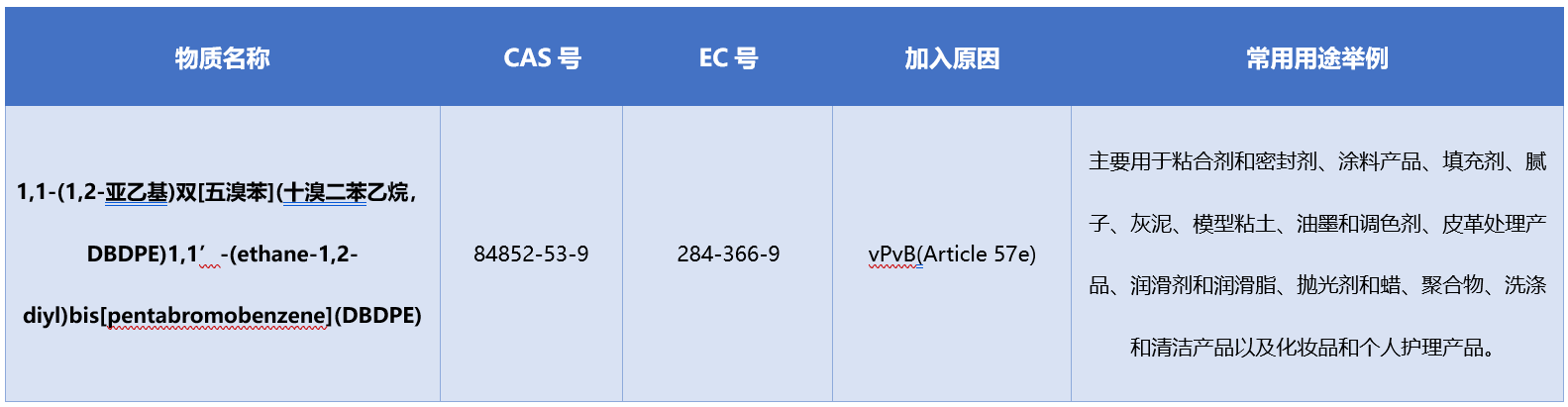
Up to now, the state of SVHC substances is summarized as follows:
Substance on SVHC Candidate List: 250 items
SVHC evaluation substance: 1 item
Substance in SVHC Intention List: 4 items
Substance to be determined: Item 1 (resorcinol)
About DBDPE
DBDPE, the full name of Decabromodiphenyl Ethane, is the mainstream bromine-based flame retardant replacing the traditional DecaBDE at present: the bromine content is high (about 81%), and the flame retardant efficiency is excellent; Strong thermal stability, not easy to decompose under high temperature processing conditions; Low mobility and low migration rate in polymer matrix. It is widely used in plastics, coatings, adhesives and other industrial products to improve fire resistance and safety. Despite its excellent performance, DBDPE still has potential environmental and health risks. Long-term exposure will lead to environmental accumulation and ecological impact, and pyrolysis products are toxic, posing a hidden danger to the health of operators and final consumers.
The related laws and regulations of SVHC substance require:
REACH regulations stipulate that when the content of SVHC in articles is greater than 0.1%, information must be transmitted in the supply chain; When the content of SVHC in articles is more than 0.1% and the annual export volume is more than 1 ton, it must be notified to ECHA.
According to the EU Waste Framework Directive, from January 5, 2021, suppliers who put goods with SVHC content exceeding 0.1% into the EU market should submit the relevant information of the goods to ECHA through SCIP database.
Warm tips
With the continuous updating of SVHC candidate list, enterprises are facing more and more control requirements. ZRLK suggested that relevant enterprises should improve their product risk awareness, investigate the supply chain as early as possible, and always pay attention to the update of REACH regulations, so as to calmly cope with the changes in regulations. Our company has a professional technical team and rich experience in product testing, which can help you easily understand whether the products are safe and compliant. If you need it, please feel free to contact us, and our engineers will serve you at the first time!